Vetted by NeuralPress's Multi-Agent Verifier for strict factual validity and event relevance. Our compliance engine cross-checks and filters search results to ensure zero false correlations or misleading content.
Projected Drone Fleet Expansion
Growth in small drone units within the Marine Corps
Primary Sources
Marine Corps fields 3,500 first-person view attack drones
The U.S. Marine Corps has accumulated thousands of first-person view drones over the span of several months, with thousands more on the way, the service said Thursday.The meteoric rise of the service’s autonomous weapons stockpile was a result of a clear edict from the top down and service member adaptability, according to Commanding Officer of the Weapons Training Battalion Col. Scott Cuomo, who spoke at the Modern Day Marine exposition in Washington.“Rewind your brain to October,” Cuomo said. “We had zero FPV attack drones in the United States. We have over 3,500 right now.”First-person view drones allow operators to watch a live feed through either goggles or a screen that provide visuals from the drone’s vantage point. Many weigh several pounds, can carry explosives and travel close to 100 mph.Once the top brass signaled the service’s shift toward modernizing its unmanned strike capabilities, the Marine Corps responded swiftly, ramping up the service’s development and utilization of FPVs.In January 2025, Commanding Generals of Training Command Maj. Gen. Anthony M. Henderson and Marine Corps Warfighting Laboratory Brig. Gen. Simon M. Doran launched the Marine Corps Attack Drone Team, recognizing the necessity of first-person view drones after the proliferation of the technology during the war in Ukraine.The strides came with the blessing of Marine Corps Commandant Gen. Eric Smith, a vocal proponent of getting FPV drones into the hands of Marines quickly.The team, based out of Marine Corps Base Quantico, works in lockstep with the Marine Corps Warfighting Laboratory to integrate the drones into the Fleet Marine Force.RELATEDPart of the integration includes increasing troops’ proficiency with the technologies through Marine Corps attack drone competitions.Marines from 3rd Marine Littoral Regiment, 3rd Marine Expeditionary Force, participated in the first attack drone competition in Okinawa, Japan, from Dec. 3 to 12, 2025.By August 2025, the service issued an official 90-page handbook providing instructions on how to properly employ drones against adversaries.Most recently, Marines with the 3rd Marine Littoral Regiment operated drones as part of the Marine Corps Attack Drone Competition at Schofield Barracks, Hawaii, in March 2026.Over a two-week period, the team trained and certified U.S. Marines as drone operators, attack drone instructors and payload specialist instructors, according to a Marine Corps X post.And during a live-fire event on April 27 at E...
First USMC MQ-58 Valkyrie CCA Drones To Arrive In 2029
The TWZ Newsletter Weekly insights and analysis on the latest developments in military technology, strategy, and foreign policy. The U.S. Marine Corps wants to field its first conventional takeoff and landing Collaborative Combat Aircraft (CCA) drones in 2029, and is also looking at the possibility of fielding similar drones with short takeoff and landing capabilities. The news comes soon after the service outlined its plans for Kratos’ XQ-58 Valkyrie, and potentially other CCAs, to be paired with its F-35s as a “bridge” to an entire family of next-generation air combat capabilities, which could include a sixth-generation crewed fighter. You can read more about the implications of that in our previous coverage. Updates on the latest developments within the Marine Corps’ CCA program were provided by Col. Scott Shadforth, a program manager for the Expeditionary and Maritime Aviation Advanced Development Team (XMA-ADT), at the annual Modern Day Marine conference in Washington, D.C., at which TWZ is in attendance. An XQ-58A seen during the type’s first flight in Marine Corps service in October 2023. U.S. Air Force The Corps’ CCA efforts currently fall under a program called Marine Air-Ground Task Force (MAGTF) Uncrewed Expeditionary Tactical Aircraft (MUX TACAIR). The MAGTF is the primary organizing concept around which the service deploys air and ground forces. Shadforth defines the CCA program as “how the Marine Corps is going after increasing the lethality of existing and future tactical aircraft in a high-threat environment.” The MUX TACAIR effort emerged out of a previous effort that the Marine Corps War Fighting Lab sponsored as part of a Rapid Defense Experimentation Reserve (RDER) with the Office of the Secretary of Defense (OSD). This earlier program was known as the Penetrating Affordable Autonomous Collaborative Killer — Portfolio (PAACK-P). The Marine Corps is kicking off its CCA efforts with a landing gear-equipped version of the XQ-58. In contrast, the previous PAACK-P program involved the rocket-assisted takeoff (RATO) variant of the XQ-58. Meanwhile, the MQ-58 designation refers to Marine-specific variants of Kratos’ Valkyrie now in development, although it remains unclear how official this is. An XQ-58 is seen being launched using the rocket-assisted method. U.S. Air Force/2nd Lt. Rebecca Abordo As Shadforth explained, under MUX TACAIR, the Marine Corps is attempting to answer the question: “How do we take that essential [XQ-58] airf...
Marine Corps Drone Dominance Includes Unmanned Logistics
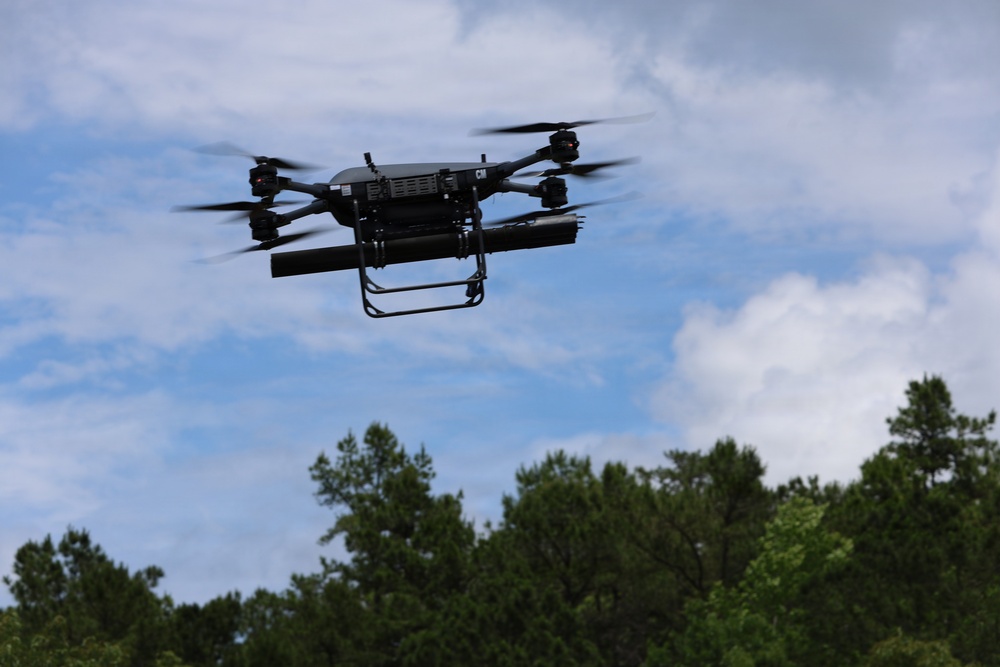
Marine Corps photo WASHINGTON, D.C. — The Marine Corps is on a mission to invest in robotic and autonomous systems to achieve "drone dominance," and that also includes unmanned logistics platforms, a service official said April 28. Gregg Skinner, program manager for the Navy and Marine Corps' small tactical unmanned air systems program office, said that unmanned systems are changing ...
The Marines are rushing to stand up a new counter-drone team as ...
A Marine unit recently struggled to confront enemy drones in realistic training, underscoring gaps as the Corps looks into counter-drone solutions.