Vetted by NeuralPress's Multi-Agent Verifier for strict factual validity and event relevance. Our compliance engine cross-checks and filters search results to ensure zero false correlations or misleading content.
Primary Sources
Fiscal and monetary restructuring of Sri Lanka: Institutional stability ...
The UAE has demonstrated, providing investors with a predictable tax environment and unfettered capital mobility naturally builds the monetary base required to maintain a stable, working-currency environmentB) The elimination of personal and indirect tax burdens A key factor in the UAE’s ability to park funds is the total absence of personal income tax, inheritance tax, and capital gains tax on individual investments. This fiscal neutrality for individuals ensures that high-net-worth individuals and global professionals view the jurisdiction not just as a workplace, but as a long-term wealth preservation hub. Sri Lanka, in contrast, has struggled with “brain drain” as professionals in medicine, IT, and academia perceive the high domestic tax burden as disproportionate to the public services provided. Adopting a framework that mirrors the fiscal clarity found in established global hubs, specifically through targeted employment income tax concessions within the Colombo Port City, serves as a strategic imperative for the retention of local talent and the attraction of high-tier international expertise. C) The institutional mechanism of fund parking and capital mobility The term “parking funds” in the context of the UAE refers to the strategic accumulation of capital in local banks and financial institutions due to the ease of repatriation, the lack of currency controls, and the high degree of regulatory certainty. The UAE’s financial ecosystem is built to ensure that once capital enters the country, it remains mobile and liquid. D) Repatriation ease and regulatory frameworks A defining feature of a global financial hub is the free movement of capital, and the UAE achieves this by allowing profits, dividends, and invested capital to be repatriated without foreign exchange controls, while relying on risk-based banking supervision and AML monitoring rather than monetary restrictions. For Sri Lanka to replicate this model, it must reduce longstanding concerns over foreign exchange scarcity and create a framework that gives investors confidence in capital mobility. In this regard, the Colombo Port City can function as a pilot jurisdiction in which capital is brought in from abroad and allowed to move out freely. E) The role of offshore and Special Economic Zones The Dubai International Financial Centre (DIFC) and the Abu Dhabi Global Market (ADGM) provide independent legal jurisdictions based on Common Law, which are exempt from UAE federal civil and commercial la...
Economy of Sri Lanka - Wikipedia
Economy of Sri LankaColombo, the financial centre of Sri LankaCurrencySri Lankan rupee (LKR, Rs)Fiscal yearCalendar yearTrade organisationsWTO, WCO, SAFTA, IOR-ARC, BIMSTEC, AIIBCountry group Developing/Emerging[1] Upper-middle income economy[2] StatisticsPopulation 21,756,000 (2025)[3]GDP $108.8 billion (nominal, 2025)[4] $342.6 billion (PPP, 2024)[5] GDP rank 71st (nominal, 2024) 62nd (PPP, 2024) GDP growth 5.0% (FY2024)[6][5] 5.0% (FY2025)[7] 4.8% (4Q 2025)[8] GDP per capita $5,003 (nominal, 2025)[4] $15,632 (PPP, 2024)[9] GDP per capita rank 120th (nominal, 2024) 111th (PPP, 2024) GDP by sector Agriculture: 7.5% Industry: 26.7% Services: 59.2% (2024)[6]Inflation (CPI) 1.60% (February 2026)[10]Population below poverty line12% lived on less than $4.20/day (2019)[11] 53% lived on less than $8.30/day (2019)[12]Human Development Index 0.776 high (2023)[13] 89th 0.630 medium (IHDI) Corruption Perceptions Index 35 out of 100 points (2025, 107th rank)Labour force 8.554 million (2025 est)[4] 49.4% participation rate (2025 est)[4] Labour force by occupation agriculture: 26.4% industry: 25.4% services: 48.3% (2024-3Q)[14] Unemployment 4.7% (2023) 4.4% (2024) 3.9% (2025)[4] Main industriestextiles & clothing, tourism, telecommunications, information technology services, banking, shipping, petroleum refining, construction and processing of tea, rubber, coconuts, tobacco and other agricultural commoditiesExternalExports $17.2 billion (2025)[15] Export goodstextiles and apparel, tea and spices, IT services, rubber manufactures, Electrical and Electronic Equipment, Fish, Seafood and Aquatic Products, Gems and Jewellery, Processed food and fruitsMain export partners USA 25.29% UK 9.18% India 6.09% Germany 5.75% Italy 5.35% (2020)[16] Imports $21.480 billion (2025)[4]Import goodsMineral fuels including petroleum product (12.3%)Machinery including computers (9%)Electrical machinery, equipment Vehicles (7.1%)Textile fabric (5%)Plastics (3.7%)Cotton (3.3%)Heavy metals (3%)Ships and boats (2.8%)Iron, steel, aluminium (2.8%)Main import partners China 22.96% India 19.30% UAE 5.57% Malaysia 4.08% Singapore 3.96% (2020)[16] FDI stock US$13.05 Billion (2019)[17] Abroad: NA[18] Current account $1.719 Billion (2025)[4] +1.6% of GDP[4] Gross external debt $37.6 Billion (34.6% of GDP) (2025)[4]Public financesGovernment debt $99.6 Billion (91.6% of GDP)(2025)[4]Foreign reserves $7.2 billion (February 2026)[19] Budget balance− 5.1% (of GDP) (2026)[20]RevenuesRs 5,305 Billion (2026 est...
Sri Lanka news, Sri Lanka economy, Sri Lanka rupee from EconomyNext.
Sri Lanka media owner's firm buys NDB's Seylan stake, reaches max limit The buying consortium between the investment firm and the bank was arranged by Asia Securities,
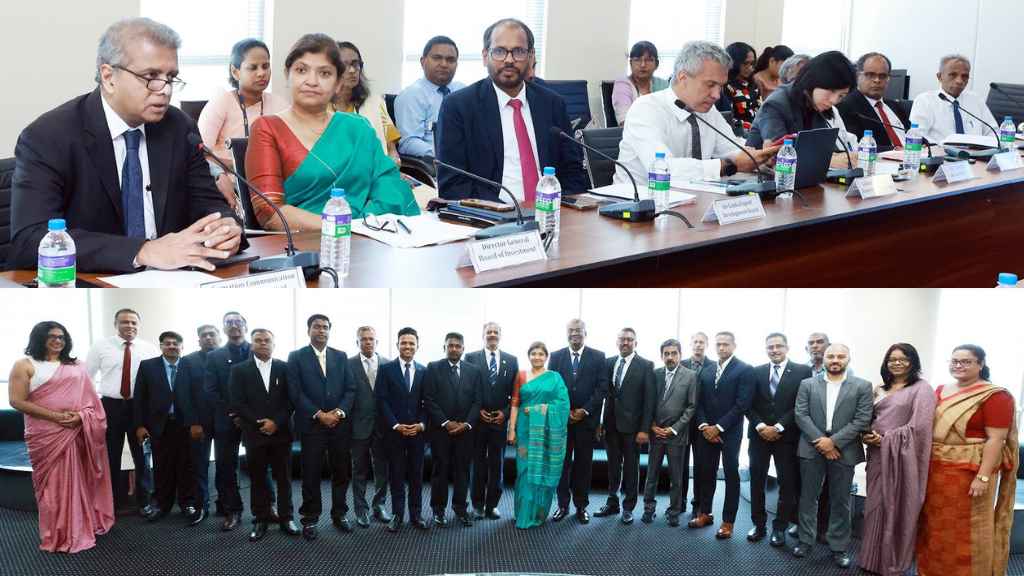
Sri Lanka's strong collaboration in capacity development helped address ...
Beyond financial assistance, Sri Lanka's strong collaboration in capacity development in public financial management and revenue administration, governance and institutional reform, social safety net expansion and targeting, fiscal transparency and digitalization, has helped the country to shape its policy responses, Treasury Secretary Mahinda ...